
Last Updated: March 29, 2026 – By Dr. Sarah Missaoui, DVM
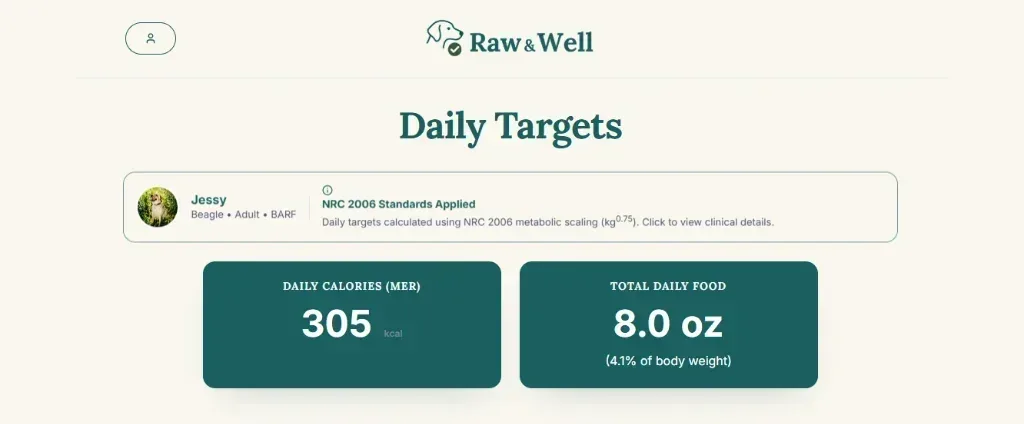
Use the RER equation as a starting point, then adjust using body condition and trends.
RER (kcal/day) is often estimated as \(70 \times kg^{0.75}\). Multiply that estimate for lifestyle, then watch weight and appetite for 2 to 3 weeks before making another change.
What Are Your Dog's Daily Caloric Needs and Why Do They Matter?
Resting Energy Requirement (RER) forms the foundation of your dog's nutrition. An NRC-based raw dog food calculator builds on this RER figure to set daily targets. It measures the exact energy your dog burns while resting in a comfortable environment.
The NRC 2006 formula uses a 0.75 exponent. A 10kg dog burns significantly more calories per kilogram of body weight than a 50kg dog. Scientists call this biological reality metabolic scaling.
The only 'magic' is consistency. Use one method to estimate calories, then use weekly trends to refine instead of switching formulas every time the scale surprises you.
Why calorie math keeps shifting
If you've been digging into raw feeding, you've probably already hit this pattern:
The confusion is normal because calorie formulas are estimates and every dog responds differently.
Calorie math feels hard because the inputs keep moving. Activity changes, treats creep in, and body condition shifts. The goal is not a perfect number. The goal is a stable trend.
Use the equation as a starting point, then adjust using body condition and weekly trends.
NRC 2006 is a reference frame. It provides context for energy estimation and diet evaluation, but it does not remove the need to adjust using your dog's real-world response.
Percent rules can miss. Small dogs often need more calories per kilogram, while very large dogs can gain easily if you scale food linearly. Use the RER estimate as a starting point and refine with feedback.
Expect calorie needs to drift with season, activity, treats, and age. Use the equation as a starting point, then adjust using trends.
How to Calculate MER (Maintenance Energy Requirement)
RER is a baseline estimate. Apply an activity multiplier based on your dog's routine.
Maintenance Energy Requirement (MER) describes daily energy use including activity and environment. Multiply your dog's RER by a reasonable factor, then adjust using weight and body condition trends.
How to use the calculator without overthinking it
Start with a weight in kg. Convert once, then keep the unit consistent.
Estimate RER, then apply a lifestyle factor. Treat the result as a starting point, not a promise.
Adjust with weekly trends. If weight or body condition moves the wrong way, change calories in small steps and re-check.
Common questions (kept short)
How many calories does my dog need per day?
Start with an RER estimate, then apply a lifestyle factor. The result is a starting point. Use body condition, appetite, and weight trends to refine.
Does the 2% rule work for weight loss?
No. 'Percent of body weight' is a crude shortcut. It can overfeed some dogs and underfeed others. Use an RER estimate and adjust slowly using weekly trends.
How do treats affect daily calorie counts?
Treats and toppers should stay a small part of the day's calories. If they become a large portion, they can dilute the nutrient density of the full diet.
Frequently Asked Questions
Why is metabolic weight (BW^0.75) better than total weight?
Energy needs do not scale linearly with body mass. Metabolic weight is a common way to estimate resting needs across sizes. Use it as a starting point, then adjust using trends.
Do spayed or neutered dogs need different calories?
Sometimes. Many dogs gain weight more easily after neutering, but the size of the change varies. Use body condition and weekly trends to adjust.
How does a dog's coat type affect calorie needs?
Environment can change calorie needs. Cold weather, indoor temperature, and activity level all matter. Treat any multiplier as a starting point and adjust with feedback.
A simple sanity check before you change anything
- If weight is drifting up, treats and toppers often explain more than the 'formula.'
- If weight is drifting down, you may be underestimating calories or overestimating food energy density.
- Either way, change calories in small steps and re-check in 1–2 weeks.
Sources & References
- National Research Council. (2006). Nutrient Requirements of Dogs and Cats. Washington, DC: The National Academies Press. View Publication →
- WSAVA Global Nutrition Committee. Body condition score chart (dog). PDF →
- Dillitzer N, Becker N, Kienzle E. (2011). Intake of minerals, trace elements and vitamins in bone and raw food rations in adult dogs. British Journal of Nutrition, 106(S1), S190–S192. DOI →