
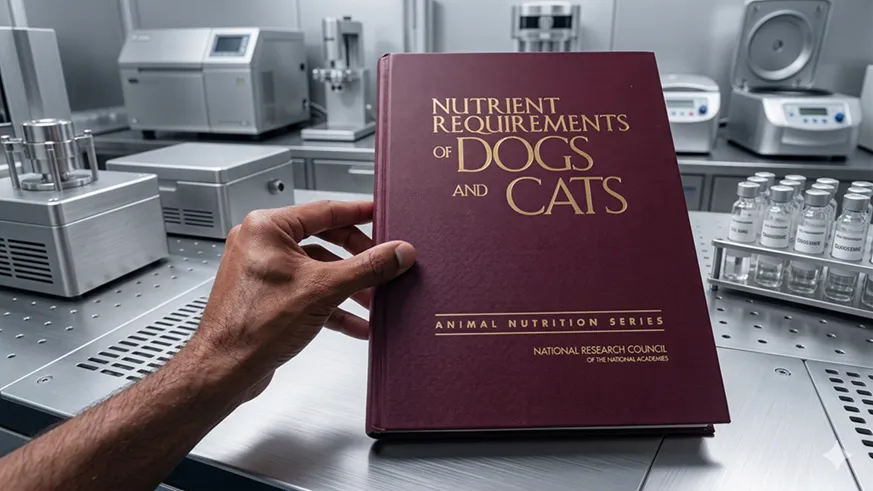
What Is NRC 2006?
In 2006, the National Research Council (NRC) published Nutrient Requirements of Dogs and Cats. It is a practical reference for canine and feline nutrient targets and safe upper limits. [1]
Verified for Clinical Accuracy by Dr. Sarah Missaoui, DVM · 21+ years canine nutrition
Quick answer
NRC 2006 is a widely used scientific reference that compiles evidence-based nutrient recommendations for dogs and cats. It's the source you cite when you want requirements to be explicit and defensible. [1]
NRC 2006 can sound like insider jargon. It is a published reference you can read and cite when you want nutrient claims to be checkable. [1]
What Does "NRC" Actually Mean?
NRC stands for the National Research Council, part of the US National Academies. The NRC report is a public document with citations and methods you can review. [1]
In 2006, it published Nutrient Requirements of Dogs and Cats. The report summarizes evidence for nutrient requirement classes and, where available, safe upper limits, with notes on life stage and context. [1]
'NRC 2006' means that specific 2006 publication. It is a reference for what nutrients a recipe should cover, not a brand or a feeding method.
Why Should You Care?
Generic raw feeding models - like the 80/10/10 rule - can be a starting point. They don't guarantee micronutrient coverage unless you verify the diet against a standard.
In a peer-reviewed analysis of bone-and-raw-food rations, at least one nutrient shortfall was common, with calcium and zinc among frequently low nutrients. [2]
These gaps are invisible at first. They eventually manifest as itchy skin that won't quit, joint stiffness in their "prime," a dull coat, or that late-afternoon fatigue that most people just shrug off as "getting older."
NRC 2006 reduces guessing. It gives you a way to translate a recipe into targets that scale with life stage, size, and energy intake. It won't remove all uncertainty, but it makes your decisions auditable.
What the NRC Is NOT
Three myths keep showing up:
- Myth #1: "The NRC was bought by big pet food."
Be careful with claims about author motives. What you can say with confidence is that the NRC publication is issued by the National Academies and cites its evidence trail. [1] - Myth #2: "NRC standards are only for kibble."
A dog's nutrient needs do not change because the food format changes. What changes is how you meet those needs, and how easy it is to verify the final totals. - Myth #3: "The NRC is just a boring table of numbers."
The tables matter, but so does the context: life stage, bioavailability, and safe upper limits. The narrative chapters explain how to interpret the numbers. [1]
How Raw & Well Uses NRC Science
Metabolic math: We calculate targets using allometric scaling and energy intake, then express nutrients in comparable units (for example, per 1,000 kcal ME when that unit matches the table). [1]
Micronutrient checkpoints: We compare your recipe against NRC nutrient targets and flag gaps so you can correct them deliberately. [1]
Scientific balance: Our engine suggests adjustments to close gaps, then shows you the tradeoffs so you can decide with your vet when needed.
Verified ingredient data: Ingredient nutrient values are sourced from USDA FoodData Central — each ingredient carries a verified FDC ID you can check yourself, not an estimate. The resulting calcium-to-phosphorus band is verified against both NRC 2006 and FEDIAF 2024 (minimum 1:1, adult maximum 2:1, growth ceiling 1.6:1).
You do not need to memorize the book. You need a workflow that turns it into checkable targets.
See it in action in the app tour.
Curious about the formulas we use? Check out our Scientific Foundation page →
Ready to check a recipe?
Let our scientific engine handle the NRC math while you enjoy the extra tail wags.
Start Your 7-Day Free TrialSources & References
- National Research Council. (2006). Nutrient Requirements of Dogs and Cats. Washington, DC: The National Academies Press. View Publication →
- Dillitzer N, Becker N, Kienzle E. (2011). Intake of minerals, trace elements and vitamins in bone and raw food rations in adult dogs. British Journal of Nutrition, 106(S1), S190–S192. View Study →