
Last Updated: May 13, 2026 – By Dr. Sarah Missaoui, DVM
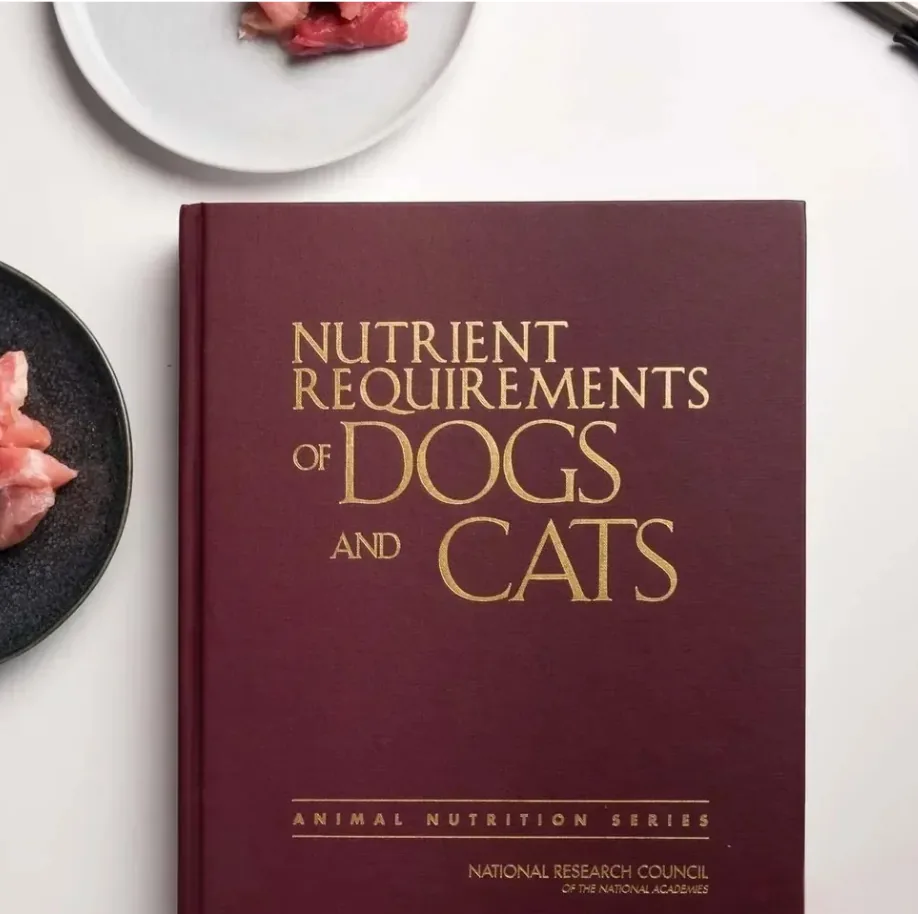
NRC 2006 is a published scientific reference defining nutrient requirement classes and safe upper limits for dogs, applied per energy intake (e.g., per 1,000 kcal ME). [1]
- NRC distinguishes three requirement classes: Minimum Requirement (MR), Adequate Intake (AI), and Recommended Allowance (RA). Where an RA exists, it includes a safety margin above minimum needs.
- A recipe meeting ingredient ratios perfectly can still miss micronutrients or exceed safe limits unless checked against NRC targets.
- Raw & Well uses NRC as the reference frame for verifying recipes cover 43 micronutrients at correct levels for your dog's life stage and energy intake — try the free NRC 2006 calculator. [1]
- Metabolic scaling (BW^0.75) is central to NRC math – percentage rules alone cannot capture what your specific dog actually needs.
Most raw feeding conversations treat ingredient percentages the same way people treat everything in raw nutrition: as a statement of truth. You hear it constantly. "Is 80/10/10 balanced?" "Yes, that's the prey model." And everyone moves on. But then someone feeds that ratio for three months, the dog looks great, and the bloodwork shows a copper spike that wasn't supposed to exist. Or zinc is low. Or taurine missed the target for that breed. The percentage was correct. The micronutrients weren't. The gap between these two things – between "the recipe looks right" and "the recipe actually covers what this dog needs" – that's where NRC 2006 sits.
I learned this in practice. You get two owners, both feeding 80/10/10 to different-sized dogs, and you check both against NRC numbers. One dog is getting three times the copper it needs from the liver component. The other is short on iodine. Same ratio. Different outcomes. Percentages don't capture that'they can't, because they're agnostic to ingredient source and micronutrient density. That's when I realized percentages were useful but incomplete. NRC 2006 is what actually tells you whether the bowl is safe or not.
This is where Raw & Well comes in. The app takes your recipe and checks it against NRC 2006 targets. You're not guessing whether 80/10/10 is balanced anymore. You're translating your actual ingredients into actual micronutrient totals, then comparing against NRC requirement classes. Your recipe becomes measurable. The standard becomes your yardstick. That's the work that matters.
What NRC 2006 Actually Defines
The National Research Council 2006 publication compiles peer-reviewed research into nutrient requirement classes and toxicity ceilings. For each nutrient, NRC establishes one or more of the following: [1]
| Requirement Class | Purpose | When Applied | Safety Margin |
|---|---|---|---|
| Minimum Requirement (MR) | Prevents clinical deficiency | Controlled conditions | None |
| Adequate Intake (AI) | Best available when RA unavailable | Limited research exists | Uncertain |
| Recommended Allowance (RA) | Target for complete nutrition | Strong research base | Includes variability buffer |
| Safe Upper Limit (SUL) | Maximum safe intake | Toxicity risk exists | Safety ceiling |
NRC applies these classes consistently across different life stages (adult maintenance, growth, reproduction) and accounts for metabolic differences using body weight scaling. You're not using a simple percentage rule anymore. You're using a metabolic framework. [1]
Why Metabolic Scaling Isn't Optional
A 10 kg Miniature Pinscher doesn't need 1/5 the zinc of a 50 kg Retriever. Metabolism doesn't work that way. It scales to body weight raised to the 0.75 power. That's why NRC uses metabolic body weight (BW^0.75) as the scaling factor. [1] When you see "zinc requirement is 15 mg per 1,000 kcal ME," that's already factoring in metabolic scaling. You apply it the same way regardless of size – calculate energy intake, apply the per-kcal target. [1]
I had two owners bring me recipes once. Both were feeding 80/10/10 to similar-composition diets, but one dog was 8 kg and the other was 25 kg. When I checked them against NRC numbers, the small dog was accumulating copper from the liver – getting three times what it needed daily. The large dog was short on iodine from the same percentage of offal. Both recipes were arithmetically identical. But they weren't safe anymore because the owners didn't scale for metabolic rate. This is exactly why percentages alone fail. They're weight-agnostic. NRC isn't. If you're checking a recipe, you have to account for how that dog's actual metabolism burns energy, not just how much it weighs.
How NRC Translates Into Recipe Review
You start with your dog's life stage and energy burn. Is it adult, growing, pregnant, or geriatric? That determines which NRC targets you use. Then you estimate or calculate metabolic energy in kcal ME – based on activity level, age, metabolism. Once you have that number, you translate your recipe into micronutrient totals per 1,000 kcal ME. This is where a calculator stops being optional. Spreadsheets miss things. Math is unforgiving.
When I review a recipe, I check the minerals first: zinc, copper, iodine, manganese. These gaps appear most often in home-prepared diets. Then the fat-soluble vitamins – A, D, E, K. Compare against NRC RA targets for your dog's life stage. [1] But also check the high side. Copper and vitamin A can accumulate. If NRC sets a Safe Upper Limit where toxicity risk is documented, stay below it. [1] If something's short, add one ingredient – green tripe for manganese, for example. Recalculate. Watch for clinical signs over weeks. These things don't show up overnight.
Why NRC 2006 Is Still the Best Reference Available
There's AAFCO – Association of American Feed Control Officials – which publishes minimum nutrient levels for commercial pet food. There's FEDIAF, the European side, which publishes complete-food guidelines. Both exist for a reason. But they don't tell you what's safe for a home-prepared diet. NRC 2006 is different. It's published by the National Academies of Sciences, which is non-commercial and research-focused. The data comes from peer-reviewed studies on nutrient requirements in actual dogs. It includes requirement classes, not just minimums, and it includes Safe Upper Limits where documented toxicity risk exists. [1] That's why Raw & Well uses it as the primary frame. Other standards exist for different purposes. NRC is the one that forces you to think about safety – not just whether your dog survives.
The catch is that NRC requires work. It's not a calculator app. It's a reference book. You have to translate it. You have to understand what it's saying. But once you do, it becomes the one yardstick you can actually defend in conversation. You're not guessing. You're not trusting social consensus. You're checking your recipe against a published standard that takes responsibility for what it claims.
Common Questions About NRC 2006
Why does NRC 2006 matter more than ingredient percentages?
Ingredient percentages show the proportion of ingredients, not whether micronutrients are actually present at safe levels. NRC provides requirement classes scaled to energy intake and Safe Upper Limits. A recipe with perfect percentages can still miss trace minerals or exceed toxicity ceilings. Percentages answer "what's the ratio?" NRC answers "is it complete and safe?"
What is metabolic weight and why does it matter in NRC?
Metabolic weight (BW^0.75) scales requirements based on metabolism rather than simple body weight. A 10 kg dog doesn't need exactly 1/5 the nutrients of a 50 kg dog because metabolism doesn't scale linearly. NRC uses metabolic energy (kcal ME) as the denominator because it accounts for metabolic differences across different-sized dogs more accurately than body weight alone.
What is the difference between RA and AI in NRC?
Recommended Allowance (RA) is set above Minimum Requirement to account for biological variability and bioavailability. Adequate Intake (AI) is used when RA data doesn't exist – it's based on available research but may not include the same safety margin. When NRC lists an RA, use that as your target. When only AI exists, that's your best available reference.