
Last Updated: May 8, 2026 • By Dr. Sarah Missaoui, DVM
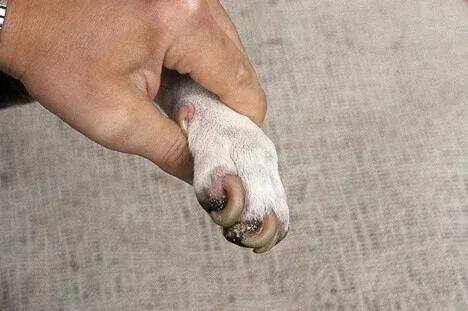
Zinc deficiency is the most common micronutrient gap in home-prepared raw diets. NRC 2006 sets the adult Recommended Allowance at 15 mg per 1,000 kcal metabolizable energy. Most muscle-meat recipes deliver 6–12 mg - a 40–60% shortfall. The symptoms - hyperkeratosis, poor coat, immune suppression - appear slowly, often months after the gap begins.
What Zinc Actually Does in a Dog's Body
The raw feeding community frames zinc as a skin mineral. That framing isn't wrong, but it's incomplete in a way that leads you to miss gaps until they're obvious. Zinc is a cofactor for over 300 enzymes. Skin integrity, immune signaling, wound closure, hormone regulation: all of it runs through zinc-dependent pathways.
You can have a dog with no visible skin problems and still be running 40% below the NRC 2006 Recommended Allowance for months. The skin disease you'd expect is a late-stage signal, not an early one.
The reason deficiency is hard to spot isn't that the symptoms are rare. It's that they're non-specific. Dull coat looks like it could be anything. Slow wound healing looks like the wound was just bad. Repeated minor infections look like bad luck. None of these point clearly to zinc. But they should.
| Recipe Approach | Estimated Zinc per 1,000 kcal ME | Bioavailability | Gap vs NRC 2006 RA (15 mg) |
|---|---|---|---|
| Muscle meat only (80/10/10 without deliberate zinc sources) | ~6–9 mg | Moderate - animal zinc absorbs better than plant sources | 40–60% below NRC RA |
| Muscle + standard organ (liver + kidney, no oysters) | ~9–12 mg | Good - organ zinc is more bioavailable than muscle zinc | 20–40% below NRC RA in most recipes |
| Muscle + organ + deliberate source (oysters, mussel powder) | ~14–18 mg | Excellent - oysters are among the densest whole-food zinc sources | Meets or exceeds NRC 2006 RA |
| NRC 2006 Recommended Allowance - adult maintenance | 15 mg | Reference standard - Table 15-1 [1] | The target. Growth stages require more. |
Estimates based on USDA FoodData Central ingredient values and NRC 2006 reference ranges. Actual delivery varies with portion consistency, ingredient source, and processing. Calculate your specific recipe - don't estimate from category averages.
There's also a bioavailability gap that most ratio-based discussions skip. Plant-based zinc sources like pumpkin seeds and hemp seeds absorb at far lower rates in dogs than zinc from animal tissue.
Adding seeds to your recipe and calling it zinc-covered is not the same as calculating zinc from measured beef kidney and oysters against 15 mg per 1,000 kcal ME. You can't estimate your way to a number. Measure it.
Why Recipes Fall Short - and Why It's Hard to See
The consensus in most raw feeding groups is that if you're feeding "organ" you're covering your minerals. I don't think that framing is accurate. I've seen the consequences of it enough times that I'd push back directly.
Organ meat is not a category. It's a collection of specific ingredients with very different nutrient profiles. Liver is high in copper and B vitamins. Kidney adds some zinc.
But "10% organ" could mean any combination, at any portion size, weighed or eyeballed - and your zinc delivery is different every time.
I had a client with a Siberian Husky who'd been raw-fed for almost three years. Recurrent ear infections. Skin scaling around the muzzle. Nobody reviewed the diet until she came to me.
When we calculated the recipe against NRC 2006 targets per 1,000 kcal ME, zinc sat at 8.2 mg – 55% of the Recommended Allowance of 15 mg. No deliberate zinc source anywhere in the bowl.
We added measured beef kidney and oyster powder. Six weeks later the ear infections had stopped. The coat improved within two months.
That case took three years before anyone looked at the numbers. She wasn't careless - she cared deeply. But a ratio framework doesn't track zinc in any unit that matters.
What's harder to communicate: a dog running at 55% of the NRC RA for zinc won't look dramatically unwell. The immune decline is gradual. The coat change is slow. Healing is just worse than it should be.
How to Correct a Zinc Gap Without Overshooting Other Minerals
The math here is straightforward once you stop working in percentages and start working in per-energy units — the NRC 2006 raw feeding calculator converts everything automatically.
Step 1: Calculate your dog's energy intake
Use 70 – body weight in kg to the power of 0.75, in kcal per day. That's the resting energy requirement (RER). Adjust upward for activity level, but RER gives you the baseline. This converts NRC 2006 per-energy targets into daily amounts for your specific dog, not a generic breed average.
How Raw & Well handles the math: Enter your dog's weight and life stage. The calculator does the RER conversion and applies NRC 2006 targets automatically.
Step 2: Express your recipe in per-1,000-kcal units
Look up the zinc content of each ingredient in USDA FoodData Central - mg per 100g for most whole foods. Calculate how much zinc your recipe delivers per 1,000 kcal ME. Compare that to 15 mg per 1,000 kcal ME (adult maintenance, NRC 2006 Table 15-1).
If you're at 9 mg, you have a 6 mg gap to close. If you're at 12 mg, it's a smaller fix.
The Raw & Well scientific solution: The app calculates zinc delivery per 1,000 kcal ME for your specific recipe and flags any gap against the NRC 2006 RA in real time.
Step 3: Add one deliberate source and recalculate everything
Oysters are the most zinc-dense whole-food option, roughly 38–78 mg per 100g depending on species (USDA FoodData Central). A small measured amount closes most gaps without overshooting. Green-lipped mussel powder is another option with good bioavailability.
After you add the correction, recalculate copper, iron, and the other trace minerals. Zinc and copper compete for absorption. Push zinc too high and copper starts to drop.
How Raw & Well automates this: Any ingredient change recalculates all 43 micronutrients at once, so you can see whether the zinc correction created a new imbalance elsewhere.
People Also Ask About Zinc in Raw-Fed Dogs
If my dog looks healthy, does zinc coverage still matter?
Yes, and this is where zinc gaps are most dangerous. A dog running at 60% of the NRC 2006 zinc target may look and act normal for months. The immune decline is gradual. Coat changes are subtle. By the time symptoms are obvious, the deficiency may have run for a year or more.
Checking coverage before visible problems appear is the whole point of calculating against NRC targets.
Can I use pumpkin seeds or hemp seeds to cover zinc?
They contain zinc, but bioavailability from plant sources is lower than from animal tissue. You'd need large amounts to hit 15 mg per 1,000 kcal ME from seeds alone, and phytate content reduces absorption further. Beef kidney, oysters, and mussel powder are more reliable for a meaningful correction.
How long does it take to see improvement after correcting zinc?
Skin and coat improvements take 4–8 weeks because coat renewal is slow. Immune function may improve faster. If the deficiency ran for a year or more, recovery takes longer. Track changes weekly and discuss persistent symptoms with your vet.
Does high bone content in a recipe affect zinc absorption?
High calcium from bone can impair zinc absorption. If your recipe is bone-heavy, the calcium load may reduce bioavailable zinc even when your raw number looks adequate. This is one more reason to read the calcium-to-phosphorus balance against the whole bowl and calculate the full mineral profile rather than optimising zinc in isolation.
Frequently Asked Questions
Does zinc deficiency always show up as skin problems?
Not always, and this is what makes zinc gaps easy to miss. Skin changes - scaling around the muzzle, a dull coat, slow-healing wounds - are the most visible signal. But zinc supports immune function and enzyme activity, so some dogs show vague lethargy or repeated infections before any coat problem appears.
A dog on a home-prepared raw diet that looks healthy may still be running low. Calculating coverage matters more than waiting for symptoms.
Can I fix zinc deficiency by adding more beef?
Beef helps, but muscle meat alone rarely hits the NRC 2006 Recommended Allowance of 15 mg per 1,000 kcal ME. You need to calculate how much zinc your actual recipe delivers, not estimate by ingredient category. Oysters, beef organs, and green-lipped mussel powder are more reliable zinc sources than extra muscle meat.
Why do some vets recommend zinc supplements while others prefer food sources?
This comes down to training and preference, not clinical evidence favoring one approach. Food-first corrections are controllable and don't risk overshooting. Supplements are precise but require careful dosing to avoid pushing copper or iron out of range. Both can work. What matters is correcting to a measured target, not just adding something and hoping.
Sources & References
- National Research Council. (2006). Nutrient Requirements of Dogs and Cats. Washington, DC: The National Academies Press. https://nap.nationalacademies.org/catalog/10668
- Dillitzer, N., Becker, N., and Kienzle, E. (2011). Intake of minerals, trace elements and vitamins in bone and raw food rations in adult dogs. British Journal of Nutrition, 106(S1), S190–S192. https://pubmed.ncbi.nlm.nih.gov/21682942/
- USDA FoodData Central. (accessed 2026-05-08). Ingredient nutrient density reference. https://fdc.nal.usda.gov/
- FEDIAF. (2024). Nutritional Guidelines for Complete and Complementary Pet Food for Cats and Dogs. Brussels: FEDIAF. View Guidelines →
- AAFCO. (2024). Official Publication. Association of American Feed Control Officials. https://www.aafco.org/