
Last Updated: May 9, 2026 – By Dr. Sarah Missaoui, DVM
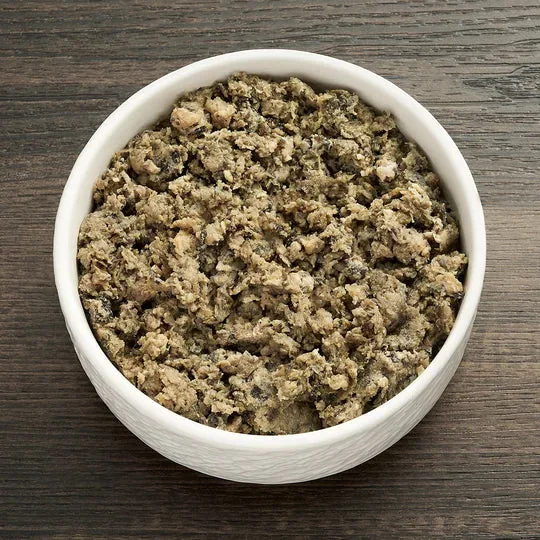
Raw & Well checks this automatically. Muscle-meat diets miss the NRC 2006 manganese target 60%+ of the time. The gap is quiet – no acute symptoms, just slower connective tissue recovery over months. Food-first fixes like tripe or shellfish close it without supplements.
The Manganese Gap Most Raw Feeders Miss
I see this pattern constantly in my clinic: a dog eating a meat-forward raw diet, owner following an 80/10/10 ratio, no obvious problems – then at the annual exam, I ask about specific nutrient tracking and the answer is always the same. "We're hitting protein and fat. Isn't that enough?"
It's not. Manganese is one reason why.
The NRC 2006 Recommended Allowance for manganese is 1.2 mg per 1,000 kcal ME. That's not a lot by weight, but muscle meat – the foundation of most raw diets – contains only 0.1 to 0.2 mg per 100 grams. A dog eating a 1,200 kcal meal built built largely on muscle meat can often end up 40-50% short of that target.
The issue isn't dramatic. There's no manganese deficiency crisis with visible collapse. It's slower. Connective tissue doesn't form as robustly. Recovery from activity takes longer. Joint support stays compromised.
You won't see it coming. Over months, this slow deficit becomes a structural liability for growing dogs, high-activity athletes, and any dog whose connective tissue is under regular stress.
Why Manganese Matters for Connective Tissue
Manganese is a cofactor for the enzyme responsible for building collagen and cartilage matrix. Without enough of it, your dog's body can't synthesize the structural proteins that hold joints stable and protect cartilage.
This is different from joint injury. It's not a torn ligament or impact damage. It's slower. A diet that doesn't support the foundational tissue that prevents injury in the first place.
In my practice, I've worked with high-drive dogs, working lines and sport breeds, on home-prepared raw diets. When owners add a manganese source on purpose and track the whole recipe against NRC 2006 per 1,000 kcal ME, the shift is consistent: fewer soft-tissue issues, faster conditioning recovery, better sustained tolerance. I don't claim manganese prevents all injuries. But closing an avoidable gap matters.
I've tracked this pattern for years. The math holds up. You're not aiming for perfection – you're aiming for a diet where the numbers don't lie.
Manganese Content: Meat vs. Food-First Sources
| Food Source | Manganese per 100g | Relative to Muscle Meat | Practical Use |
|---|---|---|---|
| Muscle Meat | 0.1–0.2 mg | Baseline (low) | Foundation of diet, requires additional source |
| Green Tripe | 0.8–1.2 mg | 6–10x higher | Practical addition, most dogs tolerate well |
| Shellfish (Mussels) | 2–5 mg | 20–50x higher | Concentrated source, portion control essential |
| Seeds / Plant Matter | 1–3 mg | Variable | Contributor only, insufficient as sole source |
| NRC 2006 RA Target | 1.2 mg per 1,000 kcal ME | Energy-based (personalized) | Validated guideline (Table 15-5) [1] |
Manganese-Rich Foods for Raw Feeding
Green tripe (the practical choice)
Green tripe contains 0.8 to 1.2 mg manganese per 100 grams, about 6-10 times more than muscle meat. It's familiar to raw feeders, tolerates freezing well, and most dogs digest it without issue. If your dog has a sensitive GI system, introduce it slowly.
Shellfish (higher density, portion control)
Blue-lipped mussels and oysters run 2-5 mg manganese per 100 grams, more concentrated than tripe. They're harder to source and more expensive, but a small portion goes further. Measure carefully. The density is much higher than muscle meat.
Seeds and plant matter (contributor, not the fix)
Pumpkin and sunflower seeds contain manganese, but you'd need large quantities to hit the NRC 2006 target – often impractical in a meat-based diet. Use them as contributors to a broader strategy, not as your primary source.
How to Check Your Dog's Manganese Coverage
Step 1: Set your target
NRC 2006 sets the Recommended Allowance at 1.2 mg per 1,000 kcal ME. For a 50-pound dog eating 1,200 kcal per day, that's roughly 1.7 mg total. Calculate your dog's resting energy requirement (70 – BW(kg)^0.75) to get your starting point.
Step 2: Add up your current sources
If you're running 60% muscle meat in a 1,200 kcal recipe – about 750g – that delivers about 1 mg manganese from muscle alone. Add 200g of green tripe (assuming 1 mg per 100g) and you're at 2 mg total, above your target. Most recipes without tripe or shellfish won't make it.
Step 3: Add one source and recalculate
If your current recipe is short, add one measured food-first source, then verify the new total before stacking another change. Raw & Well automates this: enter your ingredients and quantities, and it shows manganese per 1,000 kcal ME against your actual NRC 2006 target.
MANGANESE IN MUSCLE-HEAVY DIETS – THE DATA
Studies on home-prepared raw diets (Dillitzer et al., 2011; Stockman et al., 2013) show that 60%+ of meat-based recipes fall below NRC 2006 manganese targets when no deliberate source is added. Tripe or shellfish addition moves diets into compliance without supplements or processed ingredients. The difference isn't always visible month-to-month, but connective tissue formation and recovery patterns show measurable improvements over time when manganese coverage is consistent. [1][2]
Common Mistakes That Widen the Manganese Gap
Mistake 1: Assuming organ meat covers it
Liver and kidney contain more manganese than muscle, but not enough to hit the target on their own. A typical 5-10% organ component helps. It doesn't replace a deliberate manganese source. I've watched owners build recipes with generous organ content and still fall 30-40% short when they run the numbers. I check every time. The answer is almost always the same.
You'd expect organ meat to close the gap. It rarely does.
Mistake 2: Rotating proteins without tracking
Rotating proteins reduces allergen exposure. But if you rotate without measuring, you lose visibility into whether manganese stays consistent. A beef-heavy week might be 20% short. A lamb week might be better.
I've seen this exact dynamic repeat in practice: the owner rotates, the dog seems fine, and nobody checks whether the trace mineral coverage actually held across the rotation. Tracking shows you where your diet stands.
Mistake 3: Supplementing before checking the baseline
If you add a manganese supplement without checking your recipe first, you might overshoot – and mineral imbalances create their own problems. Fix the diet first. Measure against the reference. Only supplement if food options don't work for your dog.
People Also Ask About Manganese in Raw Diets
What happens if manganese stays low for months?
Connective tissue formation slows progressively. You might notice your dog recovering more slowly from hard activity, or showing early joint stiffness after rest. In growing dogs the impact is more pronounced because bones and cartilage are still forming. In senior dogs, a chronic gap compounds existing joint changes. That's why it's easy to overlook.
Can I just give a manganese supplement instead of food-first sources?
Supplements work, but food-first is safer if your dog tolerates it. Minerals are more bioavailable in food form, and oversupplementing one mineral creates imbalances with others. Tripe and shellfish give you manganese alongside other nutrients. If food sources don't work for your dog, supplement – but start conservative and measure the recipe.
Is manganese deficiency common in raw-fed dogs?
Chronic mild manganese gap, below NRC 2006 targets but not clinical deficiency, is very common in meat-heavy homemade diets. Visible bone or joint disease is rare because dogs get some manganese from almost all foods. The goal is closing the gap with intention.
Frequently Asked Questions
How much manganese does a dog really need per day?
NRC 2006 sets the Recommended Allowance at 1.2 mg per 1,000 kcal ME. For a 50-pound dog eating 1,200 kcal daily, that's about 1.7 mg total. The actual amount depends on your dog's specific caloric intake – which is why tracking per 1,000 kcal ME is the reliable method, not a fixed daily number.
Can manganese deficiency cause lameness or joint problems?
Manganese is essential for collagen synthesis, which supports joint integrity and cartilage formation. A chronic gap weakens the structural foundation, most critical for growing dogs or high-activity athletes. If your dog is limping, that's a veterinary exam first. Nutrition review comes after injury or disease is ruled out.
Is tripe or shellfish the better manganese source?
Shellfish is more concentrated, higher mg per 100g, while green tripe is easier to use in larger portions. Pick whichever your dog tolerates best, then track the full recipe so you know your actual manganese coverage per 1,000 kcal ME.
Sources & References
- National Research Council. (2006). Nutrient Requirements of Dogs and Cats. Washington, DC: The National Academies Press. NAP Catalog
- Dillitzer, N., Becker, N., & Kienzle, E. (2011). "Intake of minerals, trace elements and vitamins in bone and raw food rations in adult dogs." British Journal of Nutrition, 106(S1), S190–S192. DOI: 10.1017/S0007114511001870
- Stockman, J., Fascetti, A., Kass, P., & Larsen, J. A. (2013). "Evaluation of recipes of home-cooked maintenance diets for dogs." Journal of the American Veterinary Medical Association, 242(11), 1500–1505.
- USDA FoodData Central. (2026). Nutrient data for foods used in raw and home-prepared diets. Database
- FEDIAF. (2024, updated 2025). Nutritional Guidelines for Complete and Complementary Pet Food for Cats and Dogs. Brussels, Belgium: European Pet Food Industry Federation. View Guidelines →