
Updated July 21, 2026 – By Dr. Sarah Missaoui, DVM
Dogs do not "detox" when they switch to raw food. Veterinary medicine recognises no dietary detox period, and there is no mechanism by which changing a dog's dinner triggers the body to purge stored toxins. What raw-feeding forums file under "detox" – loose stool, an itchier coat, stronger breath, a few off days – is a diet change doing exactly what a diet change does. The useful part is that most of it is measurable. The loose stool that gets blamed on toxins leaving usually tracks the new bowl's fat and organ load, and a single serving of the liver people add "to help" carries about eleven times a day's vitamin A. Below is what is actually happening, in numbers, and the point where "detox" stops being a harmless story and starts hiding a problem.
So is the raw "detox period" real?
No. The detox period is a marketing frame, not a clinical one – and it is worth noticing who publishes it. Search the term and nearly every top result is a raw retailer or a brand blog describing a "healing crisis" your dog must pass through. Veterinary sources do not, because the premise fails at the first step: healthy dogs are not carrying a reservoir of diet-borne toxins waiting for a better food to release them. The Cornell Riney Canine Health Center's evidence review of raw diets describes benefits and risks in detail and never once invokes a detox phase, for the simple reason that the phenomenon has never been demonstrated.
That does not mean owners are imagining the symptoms. They are real. The disagreement is only about the cause – and "toxins" is the one explanation that has no biology behind it.
Where the "toxin purge" story comes from
The story usually runs like this: kibble is contaminated with aflatoxins, heavy metals, and preservatives; a nutrient-dense raw diet supercharges the liver; and the liver then flushes years of accumulated poison, which you see as diarrhoea and skin flares. It is a tidy narrative. It also misreads how the liver works.
Detoxification is not an event the body saves up for a diet change. It is continuous, enzymatic housekeeping – the liver processes metabolic by-products and compounds every hour of every day, on kibble, on raw, on anything. No food "activates" it into a special purge, and no diet gives it a backlog to clear. The dog's own metabolism is the relevant chemistry here, not the label on the bag. It is telling that the same narrative credits the liver with heroic cleansing while recommending you feed it more organ meat to help – two ideas that pull in opposite directions once you look at the actual nutrient load, which the section below does.
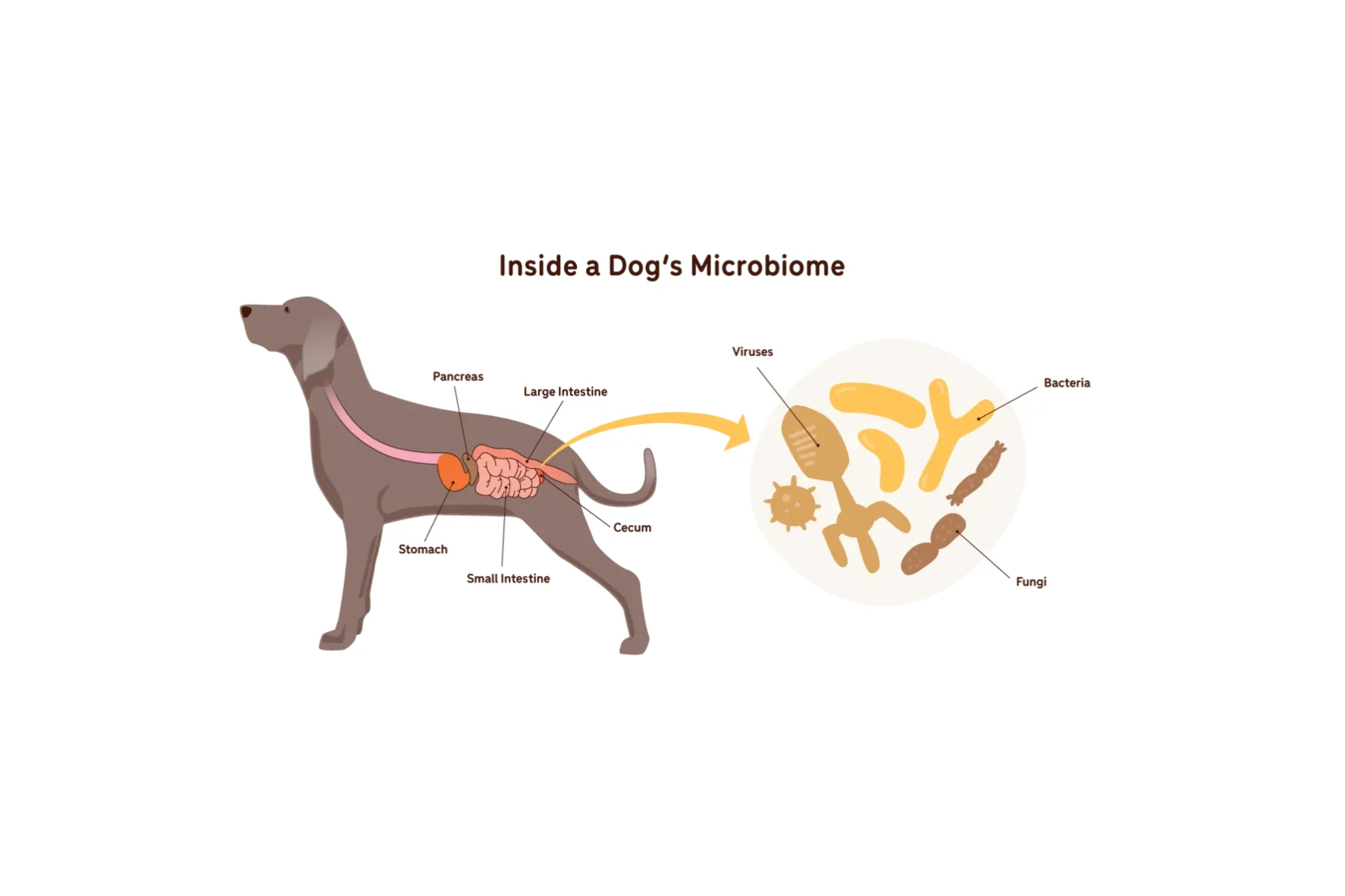
There is real science on what a raw-versus-kibble switch changes: fresh diets shift stool consistency, faecal microbiome composition, and some blood parameters, and studies on macronutrient digestibility and serum chemistry in dogs fed raw versus extruded diets document exactly that. None of it describes toxin excretion. It describes a gut adapting to different substrates – which is adaptation, not detox.
What's actually behind each "detox" symptom
Take the "detox" symptom list apart and each item has a plain-language cause that has nothing to do with poison leaving the body.
- Loose or frequent stool – the big one. This tracks two measurable things: how fast you changed the food, and how much fat and organ the new bowl carries. More on the numbers in a moment, but this is the symptom most often mislabelled, and the one loose stool during a transition is worth reading in full if it is what you are seeing.
- A stronger or "different" smell – breath, coat, ears. Raw diets change what the gut ferments and what the skin's sebum is built from. A change in odour is a change in inputs, not evidence of something toxic venting out.
- More shedding or a coat that looks worse before better. Coat turnover runs on a weeks-to-months cycle and responds to season, stress, and fat and fatty-acid intake. A switch that coincides with a seasonal moult gets the credit the calendar deserves.
- Itchy skin, waxy ears, weepy eyes. These are the ones I most want owners to stop attributing to detox, because they are the most likely to be something else: an environmental allergen, a parasite, or a genuine reaction to a new protein. Calling a flare "detox" is the exact move that delays a diagnosis.
Here is the rule of thumb I give owners, and it settles most of these on the spot: if a symptom would worry you in a dog that had not changed diet, it should worry you in one that has. A diet change does not make vomiting, blood, weight loss, or a miserable dog benign. Timing is not a diagnosis. Mild, improving, and the dog is bright – that is adaptation you can manage. Anything else earns a workup, and dogs whose gut symptoms drag on despite a settled diet are exactly the ones who need a proper diet-trial workup with their vet rather than another week of waiting for a "phase" to end.
The loose stool, in the unit that actually explains it
Strip away the toxin story and transition diarrhoea comes down to arithmetic the calculator does for you. A dog moving off a moderate-fat kibble onto rich raw cuts can meet a large fat jump all at once, and fat is the single most reliable trigger of loose stool in a switch. Measured the way a clinician measures it – grams of fat per 1,000 kcal, using the USDA-sourced figures behind the Raw & Well calculator – a bowl built on duck runs about 98 g of fat per 1,000 kcal and one built on fatty ground beef about 64, both of them crowding the NRC 2006 safe upper limit for total fat of 82.5 g per 1,000 kcal. Build the same meal on rabbit (about 22) or a chicken thigh-and-breast blend (about 37) and the gut has far less to absorb in a hurry. Same "I switched to raw," very different load – and the difference, not a detox clock, is usually what decides whether the first fortnight is smooth. If you want to see where your own bowl lands against those NRC 2006 targets, that is the number the calculator surfaces.
The liver "detox supplement," in actual numbers
The advice to spoon in extra liver or a milk-thistle blend "to support detox" is where the myth does the most quiet harm, and it is the cleanest thing to answer with a figure. Beef liver is not a cleanser; it is one of the most nutrient-concentrated foods you can put in a bowl. In the calculator's USDA-sourced database, 100 g of raw beef liver carries about 16,560 IU of vitamin A. FEDIAF puts an adult dog's vitamin A requirement at roughly 1,515 IU per 1,000 kcal – so for a dog eating around 1,000 kcal a day, that 100 g serving delivers close to eleven times a full day's vitamin A. Even a modest 30 g spoonful runs to about 4,970 IU, roughly three days' worth in a single topping.
None of that is acutely toxic in one meal – the same FEDIAF framework sets the nutritional maximum far higher, and NRC 2006 notes that dogs absorb 80–90% of dietary vitamin A and bank the surplus in the liver. That storage is the point. Fat-soluble vitamins accumulate, so "a bit of liver every day to help detox" is precisely how a diet drifts toward too much of a fat-soluble vitamin over weeks, which is a real risk worth its own read on over-supplementing a raw diet. And the near-term effect is more immediate: a sudden rich-organ load is itself a classic cause of the loose stool that then gets logged as detox. So the liver-support ritual manages to be wrong twice – the liver needs no help clearing an imaginary backlog, and the "help" is a measurable cause of the very symptom it is meant to explain.
How long does it last, and when it isn't adaptation at all
There is no fixed detox timeline because there is no detox – but there is a reasonable expectation for genuine adjustment. When a switch is done gradually and the diet is sensible, mild stool changes generally settle within a week or two as the gut adapts to the new fat, fibre, and protein mix. If they don't – if things are dragging on, or getting worse rather than better – the honest reading is not "still detoxing." It is that the plan needs changing or the dog needs looking at. Slow the transition down, hold one variable at a time so you can actually read the result, and keep a short note of what changed and when.
Some signs skip the waiting entirely. Blood in stool or vomit, repeated vomiting, black tarry stools, real lethargy, dehydration, or steady weight loss are not detox milestones; they are reasons to call your veterinarian now. A dog already managing a diagnosed condition needs the plan reconciled with that condition rather than filtered through a wellness story. The goal is a dog you can read clearly – and "detox" is mostly a way of not reading the signal in front of you.
Frequently Asked Questions
Do I need a liver or milk-thistle supplement to help my dog detox off kibble?
No. A healthy dog's liver runs its detoxification chemistry continuously, on any complete diet, and no food change flips it into a special purge. Adding organ "to help" backfires: 100 g of beef liver already carries about 16,560 IU of vitamin A – near eleven times an adult dog's daily FEDIAF requirement – and a sudden rich-organ load is itself a common cause of the loose stool people then read as detox. The exception is a dog already diagnosed with liver disease or on daily medication - clear any supplement with that dog's vet first.
Why is my dog itchier after switching to raw?
Itching after a diet change is not toxins leaving the skin. It is more often coincidence with the season, an environmental allergen, a parasite, or a real reaction to a new protein. Hold the diet steady instead of swapping ingredients, and if the itch climbs or the ears and skin flare, treat it as something to diagnose with your veterinarian rather than a phase to wait out.
Sources & References
- National Research Council. (2006). Nutrient Requirements of Dogs and Cats. Washington, DC: The National Academies Press. Total-fat safe upper limit (82.5 g/1,000 kcal), vitamin A absorption and hepatic storage, retinol-equivalent conversion. View Publication →
- FEDIAF. (2024). Nutritional Guidelines for Complete and Complementary Pet Food for Cats and Dogs. Brussels: European Pet Food Industry Federation. Adult-dog vitamin A recommendation (≈ 1,515 IU/1,000 kcal) and nutritional maximum. View Guidelines →
- USDA FoodData Central. Beef liver, raw (FDC 169451): vitamin A 4,968 µg RAE per 100 g, as used in the Raw & Well IngredientDatabase; fat figures for the raw proteins cited. FoodData Central →
- Cornell Riney Canine Health Center. Raw foods for dogs: evidence-based advice. Cornell University College of Veterinary Medicine. Cornell Riney →
- Algya KM, Cross T-WL, Leuck KN, et al. (2018). Apparent total-tract macronutrient digestibility, serum chemistry, and faecal characteristics of dogs fed extruded, mildly cooked, and raw diets. Journal of Animal Science. PMC full text →