
Updated September 29, 2026 – By Dr. Sarah Missaoui, DVM
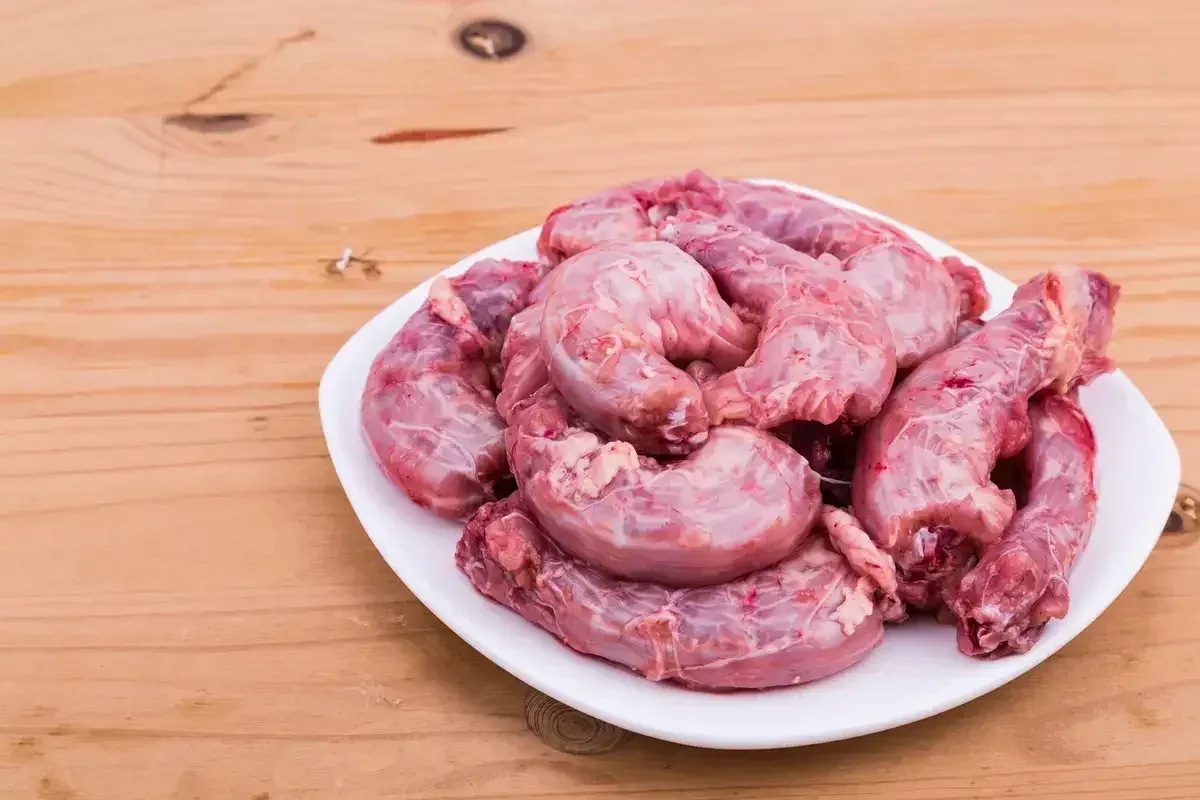
Yes – raw chicken bones are safe for most healthy dogs, while cooked chicken bones are not. Cooking dries the bone and makes it splinter. Feed soft, non-weight-bearing raw pieces (necks, wings, backs) sized too large to swallow whole, and keep edible bone near a tenth of the diet. The detail almost every guide skips: three common chicken bones carry different amounts of calcium – from 920 to 1,330 mg per 100 g in the Raw & Well IngredientDatabase (bone-in values estimated) – so "just add a bone" is not one nutritional decision.
Raw is fine. Cooked is the emergency.
The single most important line in this whole topic is the raw-versus-cooked one. Raw poultry bone is pliable; a dog's molars crush it and the fragments pass. Cooking pulls the moisture out and changes the bone's structure, so it snaps into rigid shards instead of crushing – and those shards are what puncture a gum, lodge in the throat, or perforate the gut. If your dog grabbed a cooked bone off a plate, that is a call-your-vet situation, not a raw-feeding question, and it sits outside what this page covers.
Raw chicken also carries a bacterial load – Salmonella and Campylobacter live on poultry. A healthy dog's short, acidic digestive tract handles that far better than a human gut does, so the practical risk is mostly yours to manage: wash hands and bowls, thaw in the fridge rather than on the counter, and skip raw bones entirely for a dog that is immunocompromised or lives with an infant or an unwell person. Handled sensibly, the pathogen question is a hygiene habit, not a reason to avoid bones.
Which raw chicken bones are safe, matched to your dog's size
Safety here is mechanical: the piece has to be too big to bolt down, and soft enough that teeth crush rather than crack against it. That points you toward the non-weight-bearing parts of the bird.
- Small dogs (under ~10 kg): chicken necks. Cartilage-rich, soft, and slow to eat.
- Medium dogs: chicken wings – a balanced piece of meat, skin, and bone that forces some chewing.
- Medium to large dogs: chicken backs and carcasses, which carry the most calcium of the three (more on why that matters below).
The same logic extends past chicken: turkey necks suit large dogs, duck necks and wings work as a rotation, and lamb ribs give a meatier chew. What all of these share is that they are edible bone, not recreational bone.
The pieces to leave out are just as specific. Cooked bones of any kind. Weight-bearing marrow and knuckle bones from cattle – they are harder than canine enamel and are a classic cause of a slab fracture, a painful crack of the large chewing tooth that usually ends in an extraction. And small, sharp pork rib bones, which are a genuine choking shape. A bone that is denser than the tooth is not a chew; it is a dental bill.
How much calcium a chicken bone actually adds
This is the part the rest of the internet leaves out, and it is where the real decision lives. "Bone gives calcium" is true but useless, because the three chicken bones owners reach for most do not deliver the same amount. These are the calculator's own per-ingredient figures, drawn verbatim from the Raw & Well IngredientDatabase, where bone-in calcium and phosphorus are estimates, flagged as such in the app:
| Chicken raw meaty bone (per 100 g) | Calcium | Phosphorus | Its own Ca:P |
|---|---|---|---|
| Chicken neck | 1,150 mg | 604 mg | 1.90 : 1 |
| Chicken wing | 920 mg | 500 mg | 1.84 : 1 |
| Chicken back / carcass | 1,330 mg | 679 mg | 1.96 : 1 |
Read down the calcium column and the point lands on its own. A chicken back carries about 1.4 times the calcium of a chicken wing, gram for gram. Swap a 100 g wing for 100 g of back – two things an owner treats as "a raw meaty bone" – and you have moved the calcium in that meal by 410 mg. Bone percentage does not rescue you either: the neck sits at 36% bone yet out-delivers the wing at 44% bone, because the mineral density of the bone matters as much as how much of it there is.
For scale, NRC 2006 sets an adult dog's calcium recommended allowance at 1.0 g per 1,000 kcal and phosphorus at 0.75 g. A single 100 g serving of chicken back supplies 1.3 g of calcium – and FEDIAF puts the adult calcium safe upper limit at 6.25 g per 1,000 kcal. For a dog eating in the region of 1,000 kcal a day, that one piece of back covers the full day's calcium allowance on its own – about a fifth of the way to that ceiling.
Why "ten percent bone" can still miss the target
The familiar rule – keep edible bone around 10% of the diet – is a fine starting point and a poor finishing point, because it controls how much bone goes in without controlling what the bone does to the ratio. What NRC 2006 and FEDIAF actually judge is the calcium-to-phosphorus balance of the entire diet, which FEDIAF holds between 1:1 and 2:1 for adult dogs. Bone is calcium-heavy; muscle meat is the opposite, carrying almost no calcium and a lot of phosphorus.
Watch what that does to a simplified two-ingredient meal for a 20 kg dog eating about 400 g a day. Start with 100 g of chicken wing and 300 g of boneless chicken breast:
- Calcium: 920 + 12 = 932 mg
- Phosphorus: 500 + 645 = 1,145 mg
- Whole-meal ratio: 0.81 : 1 – below the 1:1 floor
A whole chicken wing, and the meal is still calcium-short, because phosphorus-rich breast meat outweighs it. Now swap the wing for 100 g of chicken back and change nothing else:
- Calcium: 1,330 + 12 = 1,342 mg
- Phosphorus: 679 + 645 = 1,324 mg
- Whole-meal ratio: 1.01 : 1 – inside the band, at 1.3 g of calcium
Same "10% bone," same 100 g of raw meaty bone, and the meal swings from below the 1:1 floor to just inside the band. The mistake I see most in raw-feeding consults is not feeding bones – it is assuming any raw meaty bone is interchangeable with any other. It is not, and eyeballing a percentage will never surface that. This is precisely the gap a calculator built on the ingredient's real numbers is meant to close.
Stool is your calcium gauge
Between weigh-ins and calculations, your dog gives you a daily readout. Bone changes stool faster and more visibly than almost anything else in a raw diet, so it is a useful, if blunt, feedback signal:
- White, chalky, crumbly stool: a sign of too much bone. Ease the bone portion down and reassess.
- Straining or hard, infrequent stools: often bone excess tipping into constipation.
- Firm, dark, and formed: the balance your dog is looking for.
Stool tells you the direction to move; it does not tell you the number. Persistent loose stool, in particular, is not automatically a bone problem and deserves a wider look at the whole diet rather than a reflexive bone increase.
Gulpers, seniors, and dental disease: when to grind or skip
Whole bones assume a dog that chews. Plenty do not. A gulper that swallows a wing whole gets none of the mechanical benefit and all of the choking risk, so for fast eaters the answer is a larger piece that cannot be bolted, a slow-feeding setup, or ground bone. Ground bone is the quiet workhorse here: it carries the identical calcium and phosphorus of the whole piece with none of the fracture or obstruction risk, which makes it the right call for small dogs, seniors, and any mouth with periodontal disease, loose teeth, or pain on chewing. Dental status outranks the nutritional wish list – a dog in pain should not be working a bone to hit a calcium target you can meet by grinding it.
Can puppies eat raw chicken bones?
Cautiously, and never casually with large-breed puppies. Growing skeletons are far less forgiving of a calcium swing than adult ones: excess calcium during growth is linked to developmental orthopedic disease, and a large or giant-breed puppy is the highest-stakes case of all. If you feed bone during growth, it belongs inside a growth-stage plan with the mineral targets worked out, ideally with your veterinarian in the loop – not judged by the same "looks about right" eye that gets an adult dog by.
Frequently Asked Questions
How often should raw chicken bones go in the bowl?
Frequency matters less than the running total. Aim for edible bone near a tenth of the whole diet across a week, with the calcium-to-phosphorus ratio held inside 1:1 to 2:1. One dog thrives on a bone-in meal most days; another does better with a couple a week backed up by ground bone. The stool tells you which, not the calendar.
Can I use ground chicken bone instead of whole bones?
Yes, and it is the safer route for a lot of dogs. Ground bone delivers the same calcium and phosphorus as the whole piece without the choking or tooth-fracture risk. You give up the teeth-cleaning chew, but you keep full control of the mineral load – a fair trade for gulpers, small dogs, and dogs with dental disease.
Do raw chicken bones carry Salmonella?
Raw poultry can carry Salmonella and Campylobacter. Healthy dogs handle a normal bacterial load far better than people do, so the real exposure is in your kitchen: wash hands, bowls, and surfaces, thaw in the fridge, and skip raw bones for immunocompromised dogs or homes with an infant or an unwell person.
Sources & References
- National Research Council. (2006). Nutrient Requirements of Dogs and Cats. Washington, DC: The National Academies Press. Adult calcium and phosphorus recommended allowances and Ca:P range. View Publication →
- FEDIAF. (2024, updated 2025). Nutritional Guidelines for Complete and Complementary Pet Food for Cats and Dogs. Brussels: European Pet Food Industry Federation. Adult Ca:P band (1:1–2:1) and calcium safe upper limit (6.25 g/1,000 kcal). View Guidelines →
- USDA FoodData Central. Nutrient composition for chicken neck (FDC 172382), wing (FDC 2727568), back (FDC 171469), and breast (FDC 2646170), as used in the Raw & Well IngredientDatabase. FoodData Central →
- U.S. Food and Drug Administration. Bones and other items can obstruct or injure the digestive tract. FDA animal health literacy →
- Dillitzer N, Becker N, Kienzle E. (2011). Intake of minerals, trace elements and vitamins in bone and raw food rations in adult dogs. British Journal of Nutrition, 106(S1), S190–S192. DOI →
- WSAVA Global Nutrition Committee. Global nutrition guidelines and diet-assessment tools. WSAVA →