
Last Updated: May 13, 2026 – By Dr. Sarah Missaoui, DVM
NRC 2006 doesn't set a Recommended Allowance for taurine – it assumes endogenous synthesis. But research on dilated cardiomyopathy (DCM) in raw-fed dogs shows that assumption breaks down when recipes lack taurine-containing ingredients. According to Dr. Sarah Missaoui, DVM, most muscle-meat-dominant raw recipes deliver functionally zero taurine and zero precursor amino acids in sufficient quantity to bridge that gap.
Raw & Well tracks taurine delivery across all 43 micronutrients, so this gap gets caught and corrected before the heart signals the problem through symptoms like exercise intolerance or sudden collapse.
Most raw feeding conversations miss the taurine question entirely
The raw feeding community talks about taurine the same way it talks about everything: ingredient categories. You hear about whether you need to add heart. Whether beef is better than chicken. Whether organ rotation covers it. That conversation is useful as a starting point, but it doesn't reach the actual question, which is whether taurine conversion is covered in the bowl your dog eats every day.
Most owners assume variety solves this. Feed three proteins, rotate organs, include different tissues, and you've covered the bases. The logic makes sense. It fails on taurine because variety of muscle meat and organs from land animals doesn't solve a taurine problem - it just redistributes the same near-zero contribution across different proteins.
You can't look at the bowl and tell whether conversion is covered. Both of those things happen regularly, and neither one is a useful response to the actual situation.
What taurine actually is and why it matters for the heart
Taurine is a conditional amino acid. Unlike most amino acids, dogs can synthesize taurine from methionine and cysteine - but only under specific dietary conditions. When those precursors fall short or when taurine-containing ingredients aren't present, the heart has to work without adequate taurine available.
In the heart muscle, taurine maintains cellular membrane stability and supports the electrical signaling that coordinates heartbeats. Without it, the ventricle weakens - dilates - and the heart's ability to pump blood declines. This is dilated cardiomyopathy, or DCM. It's reversible if caught early. It's fatal if allowed to progress.
The issue isn't that raw feeding causes DCM. The issue is that measurement of taurine delivery almost never happens in home-prepared raw diets. Owners measure protein percentage or macronutrient ratios. Taurine gets assumed or ignored.
Taurine content by ingredient source
| Ingredient | Taurine per 100g | Role in Recipe | Notes |
|---|---|---|---|
| Beef muscle | 30–50 mg | Protein base | Minimal taurine |
| Chicken muscle | 20–35 mg | Protein base | Even lower than beef |
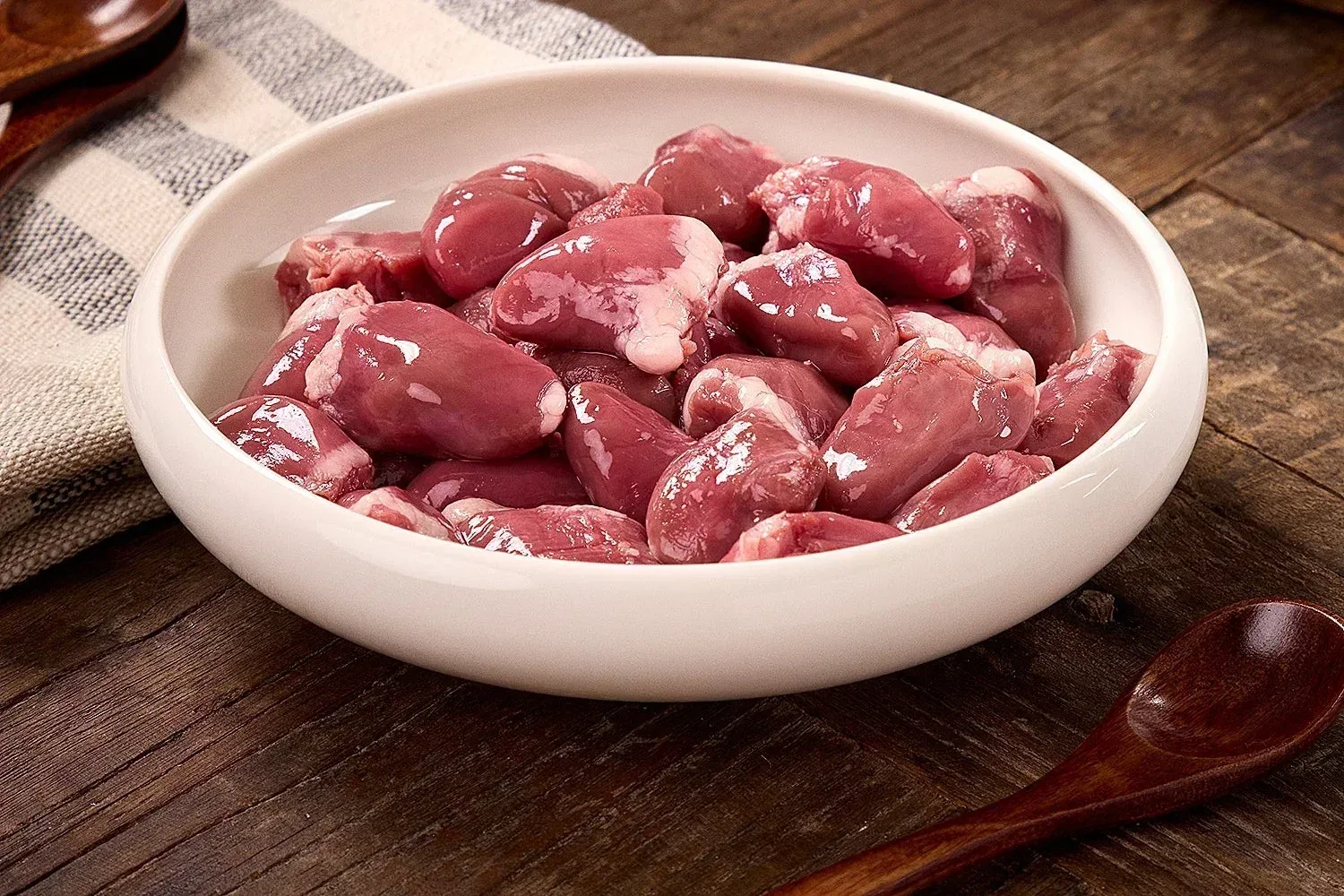
| Beef heart | ~65 mg | Muscle portion | Top muscle-meat taurine source |
| Salmon (whole) | 150–250 mg | Marine protein | High taurine + omega-3s |
| Sardines (whole, canned) | 120–180 mg | Marine protein | Practical weekly addition |
| Taurine powder (supplement) | 100% pure | Direct supplementation | Most reliable control |
How to ensure taurine coverage without complicating the recipe
Step 1: Audit current sources
Go through your recipe and identify which ingredients contain meaningful taurine. Muscle meat contributes minimally. If you're feeding beef and chicken with organ rotation but no heart, no fish, and no supplement, you're functionally at zero.
I used to think that if you included liver, kidney, and spleen, the nutrient profile handled itself. It doesn't work that way with taurine. Those organs don't contain it.
Step 2: Add one deliberate source
Either include whole fish once or twice weekly, add beef heart to the muscle portion, or supplement with taurine powder. Whole heart tissue is the simplest addition – most dogs tolerate it well, and 100–150g per week covers taurine need for an adult medium dog.
The Raw & Well scientific solution is measurement. Don't guess whether you've covered taurine. Calculate it.
Step 3: Verify your numbers
Use ingredient nutrient databases to confirm taurine delivery per 1,000 kcal of the recipe. Most adult dogs eating 800–1,200 kcal per day need 400–1,200 mg of taurine daily depending on body weight and conversion efficiency. Raw & Well handles the math automatically.
Why taurine deficiency often goes unnoticed until damage appears
DCM doesn't announce itself in week one of a taurine-deficient diet. It builds silently over months. Some owners notice subtle changes: the dog tires more easily on walks, seems reluctant to play, lies down more frequently. Others see nothing obvious until the dog collapses or starts coughing from fluid backup in the lungs.
By that point, cardiac remodeling is advanced. The heart has already begun to change shape and function in response to chronic taurine deficit. Intervention still works if you're fast, but the recovery timeline extends dramatically.
The prevention window is wide. Six months of adequate taurine delivery prevents the problem entirely. Six months of near-zero taurine can push you toward a diagnosis that requires cardiac ultrasound and intensive dietary correction. That's a meaningful difference.
In my practice, I see owners who did everything else right. Real food, careful sourcing, organ rotation in place. But they overlooked taurine because nobody in their raw feeding community brought it up. It's a knowledge gap more than a care gap. Once they understand that taurine isn't assumed in a muscle-meat-dominant diet - that it requires deliberate sourcing or supplementation - the correction is straightforward and the outcomes improve quickly.
NRC 2006 & TAURINE – What the standards actually sayNRC 2006 sets no Recommended Allowance for taurine in dogs because the assumption is that endogenous synthesis from methionine and cysteine meets requirements. But that assumption collapses when dietary taurine is absent AND precursor amino acids fall short. Dillitzer et al. (2011) documented taurine among the most consistently deficient micronutrients in home-prepared raw diets.
RAW & WELL INSIGHT – DR. MISSAOUI
In my clinical experience, taurine deficiency in raw-fed dogs follows a predictable pattern: a conscientious owner feeding muscle meat and organs, with no marine component and no deliberate taurine source. The deficiency isn't from negligence. It's from a gap in how raw feeding knowledge is shared. Once owners understand that taurine concentration in land-animal tissues is essentially zero - and that fish and heart are the practical sources - the correction becomes routine.
Source: NRC (2006). Dillitzer et al., Br J Nutr, 106(S1):S190–S192, 2011.
People Also Ask About Taurine in Raw Diets
What happens if a dog's taurine levels are low but no symptoms have appeared yet?
The heart muscle begins to weaken silently. Cardiac remodeling starts at the cellular level - taurine depletion affects membrane stability and electrical signaling - before any sign shows up clinically. Echocardiography can detect early changes before exercise intolerance or collapse appears. Early correction at this stage has the best outcomes.
Can a dog recover heart function if taurine deficiency has caused DCM?
If the damage is still in the remodeling phase - weeks to months of deficiency - yes, correcting taurine intake and supplementing can reverse it within weeks. If structural damage is advanced or if the heart has already begun to fail mechanically, recovery is slower and less complete. Early intervention is why measurement matters.
Is taurine supplementation safe if the recipe already includes some taurine sources?
Yes. Taurine has no established upper limit of safety in dogs. The only risk is under-dosing and missing the target. Over-dosing taurine itself causes no known harm. The concern with supplementation is double-counting - if heart tissue provides 300 mg daily and you add 500 mg, you're actually delivering 800 mg, which is still safe but wastes money. That's why calculation matters.
Frequently Asked Questions
Can taurine deficiency be reversed if caught early?
Often yes. If dilated cardiomyopathy hasn't caused structural heart damage, correcting taurine intake and adding supplementation can reverse the condition within weeks to months. Echocardiography confirms recovery. The critical word is early - waiting until the dog shows clinical signs of heart failure extends the timeline and increases permanent damage risk.
Why do some raw-fed dogs develop DCM while others on identical recipes don't?
Genetic variation in taurine metabolism, breed predisposition, and individual conversion efficiency from precursor amino acids all play roles. Giant breeds and certain genetics are at higher risk. But the safest assumption is this: if the recipe doesn't deliver measurable taurine and the dog can't synthesize enough from methionine and cysteine, deficiency will eventually surface.
Is taurine from plant sources sufficient for raw-fed dogs?
No. Dogs have minimal ability to synthesize taurine endogenously. They require dietary taurine or adequate methionine and cysteine. Plant sources contain no taurine. Animal muscle meat contains trace amounts. Heart tissue, organ meats, and whole fish are practical sources. Supplementation is most reliable when using primarily muscle meat.
How much taurine does a raw-fed dog actually need daily?
NRC 2006 sets no Recommended Allowance for taurine in dogs - it's assumed to be synthesized or provided through tissue. But research on DCM prevention suggests 500 mg to 1,500 mg per day depending on body weight and diet composition. Raw & Well calculates this based on your dog's specific energy needs and recipe, ensuring precision.
Does cooking affect taurine content in raw ingredients?
Taurine is heat-stable to moderate cooking temperatures, but high-heat processing like commercial kibble can degrade it. Raw feeding preserves taurine better than most commercial diets - but only if you're including taurine-containing ingredients intentionally. Processing isn't the problem. Absence of taurine sources is.
Sources & References
- National Research Council. (2006). Nutrient Requirements of Dogs and Cats. Washington, DC: The National Academies Press. View Publication →
- Dillitzer N, Becker N, Kienzle E. (2011). Intake of minerals, trace elements and vitamins in bone and raw food rations in adult dogs. British Journal of Nutrition, 106(S1), S190–S192. DOI →
- USDA FoodData Central. (accessed 2026-05-13). Ingredient nutrient density reference. Link →
- Spitze AR, Wong DL, Rogers QR, Fascetti AJ. (2003). Taurine concentrations in animal feed ingredients. Journal of Animal Physiology and Animal Nutrition, 87(7-8), 251–262. DOI →
- FEDIAF. (2024). Nutritional Guidelines for Complete and Complementary Pet Food for Cats and Dogs. Brussels, Belgium: FEDIAF.
- AAFCO. (2024). Official Publication. Association of American Feed Control Officials.
For specific citations referenced in this article:
- NRC 2006 – taurine synthesis from methionine and cysteine, DCM prevention
- Dillitzer et al. (2011) – taurine among most consistently deficient micronutrients in home-prepared raw diets