
Last Updated: May 16, 2026 • By Dr. Sarah Missaoui, DVM
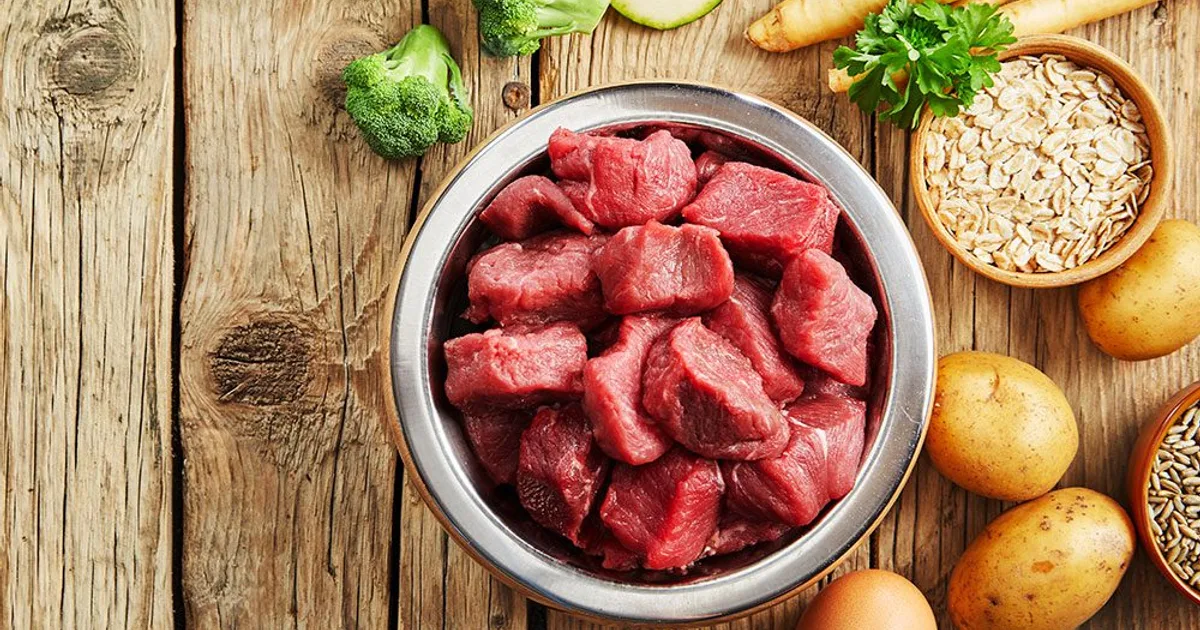
BARF and PMR are the two dominant frameworks in raw feeding. BARF includes vegetables and fruit; PMR excludes all plant matter. Both use fixed ratios - 80/10/5/5, 70/10/7/5/5/3 - as a proxy for nutritional completeness. NRC 2006 does not endorse either model. It sets 43 individual nutrient targets scaled to metabolic body weight - targets that fixed-ratio feeding frequently misses.
The documented gaps are not theoretical. Published research shows iodine, vitamin D, zinc, manganese, and vitamin E are the most commonly deficient nutrients in BARF and PMR diets. Neither model has a built-in mechanism to detect or close these gaps. Raw & Well replaces ratio logic with metabolic-math verification against NRC 2006 targets for each dog individually.
The Core Problem with Ratio-Based Raw Feeding
The raw feeding world treats ratio compliance as nutritional verification. That's the specific confusion driving most of what you'll read in BARF and PMR communities - the assumption that if your percentages are right, your diet is complete. Eighty percent muscle meat, ten percent bone, ten percent organ. Check. Done. What you actually know at that point is that you have the right categories in the right proportions. You don't know whether any individual nutrient target is met.
I've seen this play out with owners who are genuinely careful. They weigh ingredients. They rotate proteins. They track the 80/10/5/5 ratio with more discipline than most people track their own macros. And when I ask whether they've verified iodine, they look at me like I've introduced a new subject. In their framework, iodine is something that happens automatically when you feed correctly. It isn't. It's a nutrient with a specific target, and I can tell you that raw muscle meat and bone come nowhere near that number in any combination. NRC 2006 sets it at 220 mcg per 1,000 kcal ME. You'd have to actively work to get there from a standard protein rotation.
The question you should be asking isn't whether your ratio is right. It's whether the ingredients in that ratio, in the quantities you're using, produce the nutrient density NRC 2006 requires for your specific dog. Those are different questions. The first is answered by looking at your bowl. The second requires math you can't do from a percentage grid.
BARF vs PMR: Two Diets, Same Ratio, Eight Times the Difference
A few months ago I was reviewing diets for a woman feeding two Labrador mixes, four and six years old, both on PMR at textbook 80/10/5/5. One dog was on a chicken-dominant rotation – boneless thigh, chicken neck, beef liver, beef kidney. The other was eating beef heart, lamb ribs, beef liver, green tripe. She called both diets PMR and by ratio they were. When I ran the numbers, the chicken diet was pulling around 0.4 mg of manganese per 1,000 kcal ME. NRC 2006's recommended allowance is 1.25. The beef heart and tripe diet came in at 3.2 mg - eight times higher, same ratio, same percentage targets. She had no idea which situation each dog was in until that calculation.
Manganese wasn't the only gap I found. Vitamin E was a problem in the chicken rotation too. High-fat diets drive oxidative load, and vitamin E is what you're burning to offset it. NRC puts the target at 7.5 mg per 1,000 kcal ME. Neither diet was close without supplementation. The tripe rotation had better manganese and better zinc - NRC adult target for zinc is 15 mg per 1,000 kcal ME - but on iodine, both came in low. That one almost never closes from whole food alone.
Why the Gap Happens
Why does this happen structurally? BARF and PMR ratios define food categories, not nutrient densities. Beef heart and chicken thigh are both muscle meat. They do not have remotely similar nutrient profiles. Green tripe's manganese concentration looks almost nothing like beef kidney's. When you rotate proteins in a PMR diet, the nutrient output shifts every single week, regardless of whether your ratio stays identical. The percentage tells you how much of a category you're feeding. It tells you nothing about what that category is actually delivering.
This isn't an argument against BARF or PMR as frameworks. I think both establish useful scaffolding - bone fraction, organ fraction, muscle meat fraction. PMR's prey-logic is internally coherent. BARF's plant fraction helps with manganese and vitamin K in ways PMR diets often miss entirely. The limitation is what you can verify from a ratio. Category compliance: yes. Nutrient sufficiency: not without additional calculation.
What the Deficiency Data Actually Shows
When you look at what Dillitzer 2011 found, 60% of the 95 owner-fed raw rations had at least one imbalance, and about half supplied less iodine than the minimum requirement. The pattern isn't random - it follows exactly the nutrients that ratio logic can't capture, either because they're trace elements with no obvious food-category home or because their concentration swings too widely within a single category to predict from percentage.
Owners who figure this out tend to land on the same realization. They were feeding carefully for years. They believed the ratio was doing the verification work. Then someone ran the actual numbers. Iodine was sitting at 80 mcg. Manganese was 0.4. The ratio had been perfect the whole time.
Head-to-Head: BARF vs PMR vs NRC-Calibrated Feeding
| Criterion | BARF | PMR | NRC-Calibrated |
|---|---|---|---|
| Formulation basis | Fixed ratios by food category | Fixed ratios by food category | Metabolic math per individual dog |
| Iodine | Usually deficient | Usually deficient | Verified against 220 µg/1,000 kcal ME |
| Manganese | Partially covered by plant fraction | Usually deficient | Verified against 1.25 mg/1,000 kcal ME |
| Vitamin E | Often deficient in high-fat diets | Often deficient | Verified against 7.5 mg/1,000 kcal ME |
| Ca:P ratio | Variable by bone source | Variable by bone source | Calculated and verified 1:1–2:1 |
| Zinc bioavailability | Reduced by phytate from plant fraction | Higher bioavailability, lower total input | Verified per source with form noted |
| Life-stage adaptation | Manual | Manual | Automatic (puppy, adult, senior, reproductive) |
| Detects deficiencies before symptoms | No | No | Yes - all 43 nutrients flagged |
Source: NRC 2006 nutrient targets. Deficiency patterns from Dillitzer et al. (2011) and Freeman et al. (2013).
How to Use BARF or PMR as a Starting Framework
The practical answer is not to abandon BARF or PMR. They are useful scaffolds that establish the correct categories of food. The error is treating them as nutritional verification rather than formulation starting points.
A clinically sound approach combines ratio logic with NRC verification:
Step 1: Use BARF or PMR ratios to set the scaffold
Choose your model. Establish the broad food categories - bone fraction, organ fraction, muscle meat fraction, plant fraction if BARF. This gives you a workable recipe structure.
Step 2: Calculate the diet in metabolic terms
Use RER = 70 × BW(kg)0.75 with the correct life-stage multiplier. This gives you daily calorie target. Convert your recipe to grams per 1,000 kcal ME - the unit NRC 2006 uses for all nutrient targets.
Step 3: Verify the five high-risk nutrients
Check iodine, vitamin D, vitamin E, manganese, and zinc per 1,000 kcal ME against NRC 2006 recommended allowances. These are the five nutrients most consistently deficient in published raw feeding audits. If any gap exists, identify the whole-food source that closes it - kelp for iodine, oily fish or sun-dried mushrooms for vitamin D, wheat germ oil for vitamin E, green tripe or mussels for manganese, oysters or beef kidney for zinc.
Step 4: Check the Ca:P ratio, not the bone percentage
Calculate actual calcium and phosphorus from your bone source. The 10% bone target produces different Ca:P ratios depending entirely on which bone you use. NRC 2006 requires 1:1 to 2:1 for adult maintenance. Verify the number, not the percentage.
Step 5: Run a full 35-nutrient check before settling on a recipe
Raw & Well runs the complete NRC 2006 analysis automatically - all 43 nutrients verified against the correct life-stage targets, with food-first recommendations for every gap and supplement guidance where whole food cannot close the deficit.
People Also Ask About BARF and PMR
Is BARF or PMR better for dogs with allergies?
Neither model is inherently better for allergic dogs - the key factor is protein novelty and ingredient control, which both BARF and PMR support by virtue of using whole, identifiable ingredients. For a true food elimination trial, a single-protein raw diet (one novel protein source, one novel bone source, no organ variation) is more diagnostically useful than either standard BARF or PMR rotations, which introduce multiple protein sources simultaneously and make allergen identification difficult.
Can I mix BARF and PMR principles?
Yes. Many clinically sound raw diets are effectively hybrid - predominantly animal tissue with selective plant additions for specific nutrients. The classification matters less than the nutrient outcome. Adding small amounts of leafy greens for manganese and vitamin K, or seaweed for iodine, to an otherwise PMR-structured diet addresses two of the most common deficiencies without meaningfully changing the diet's protein or bone structure.
How do I know if my BARF or PMR diet is working?
Clinical signs (coat quality, stool consistency, energy level, body condition score) are useful indicators of broad dietary adequacy but are insensitive to individual micronutrient deficiencies. A dog can be iodine-deficient for years before thyroid dysfunction becomes clinically apparent. Zinc deficiency at 60% of NRC target rarely produces obvious dermatological signs in the first year. The only way to know if the diet meets NRC 2006 targets is to calculate it. Blood panel thyroid screening (T4) and coat zinc analysis are the most practical clinical proxies when a full dietary analysis is not available.
Sources & References
- National Research Council. (2006). Nutrient Requirements of Dogs and Cats. Washington, DC: The National Academies Press. View Publication →
- Dillitzer, N., Becker, N., & Kienzle, E. (2011). Intake of minerals, trace elements and vitamins in bone and raw food rations in adult dogs. British Journal of Nutrition, 106(S1), S53–S56. DOI: 10.1017/S0007114511002765
- Freeman, L.M., Chandler, M.L., Hamper, B.A., & Weeth, L.P. (2013). Current knowledge about the risks and benefits of raw meat-based diets for dogs and cats. Journal of the American Veterinary Medical Association, 243(11), 1549–1558. DOI: 10.2460/javma.243.11.1549
- Billinghurst, I. (1993). Give Your Dog a Bone. Ian Billinghurst. (Historical BARF model reference.)
- Sandri, M., et al. (2017). Raw meat-based diets for dogs: surveying the owners. Italian Journal of Animal Science, 16(1), 75–83.
- USDA FoodData Central. SR Legacy and Foundation Foods nutrient composition database. FoodData Central →
- FEDIAF. (2024, updated 2025). Nutritional Guidelines for Complete and Complementary Pet Food for Cats and Dogs. Brussels, Belgium: European Pet Food Industry Federation. View Guidelines →