
Last Updated: June 25, 2026 – By Dr. Sarah Missaoui, DVM
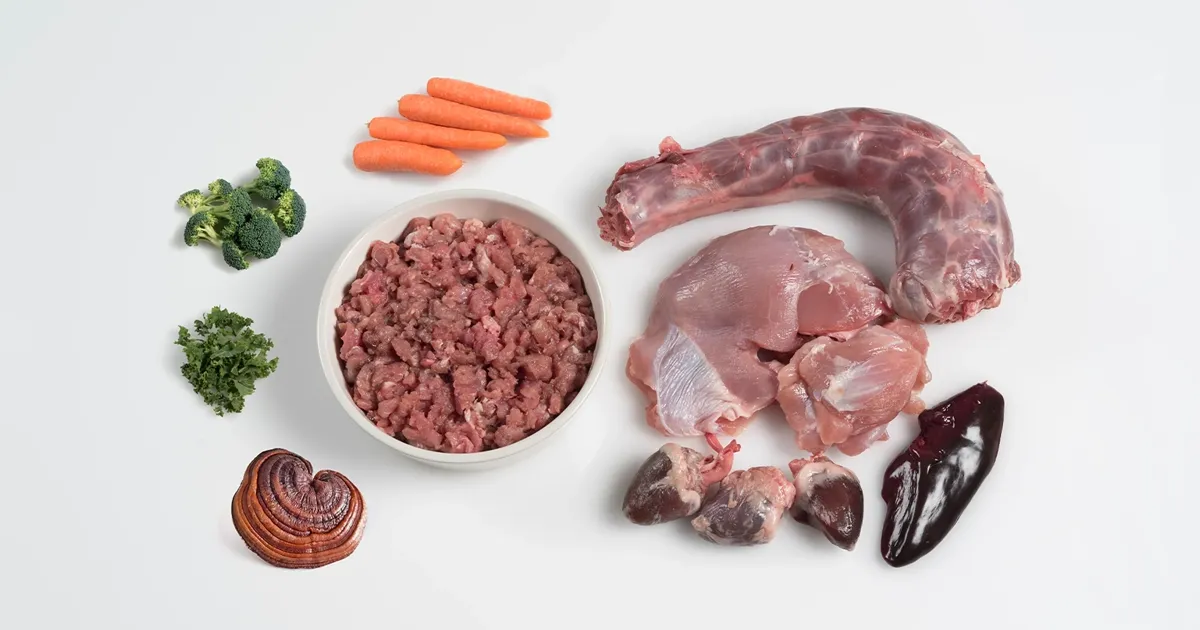
A raw feeding ingredient list is built from four working parts: muscle meat, organ, bone, and the trace sources that fall outside the headline categories. The 80/10/10 percentages describe how much of each category goes in the bowl, not what each ingredient delivers, so a category-complete list can still miss NRC 2006 targets. Liver carries vitamin A (NRC 2006 allowance 379 mcg RAE per 1,000 kcal) and most of the copper (1.83 mg); bone sets the calcium and Ca:P ratio; and manganese (1.20 mg) and vitamin E (30 IU) are the gaps no category reliably fills. Build by nutrient delivered per 1,000 kcal, not by category percentages.
Why the Ingredient List Isn't a Shopping List
Much of the advice I see about what exactly you should be putting into a raw bowl frames the ingredient list as a sort of shopping expedition. The conversation is framed around 80-10-10 type categories and, within those categories, each item is basically assumed to be more or less substitutable with the next. Muscle meat = muscle meat. Organ = organ. Bone = bone. What that way of thinking misses is that the percentages are purely describing how much of a category you put in the bowl, and nothing much about what each individual item is supposed to be delivering.
What gets lost when you're talking about category-level, in bucket lots, is that two things sitting in exactly the same category might have completely different nutrients in terms of their payload. Chicken thighs and beef hearts are both under muscle meat, but one is delivering substantial amounts of taurine and the other essentially is not. Liver and kidney are both organ, but the Vitamin A and copper load which makes liver worthwhile is not one which kidney quietly steps up to replace. And the result of all this is a recipe ingredient list which might look perfectly 'complete' on paper but actually miss the thing a particular ingredient was supposed to be there for.
Clinical note: category vs delivery
The 80/10/10 ratios were designed as a volume heuristic, not a nutrient standard. In practice the most frequently deficient nutrients in home-prepared raw diets — manganese, vitamin E, iodine, zinc — are precisely the ones that no headline category reliably carries. A list can have every column full and still leave several NRC 2006 allowances unmet, because adequacy is a property of the totals per 1,000 kcal, not of the category sheet.
A much better question – and not one which the categories were designed for – is what does this ingredient deliver per 1,000 Kcal, according to the NRC 2006 values. Liver, for example, is where you're getting your Vitamin A – and the NRC 2006 requirement is 379mcg RAE / 1000 Kcal for adult dogs - a requirement which disappears the moment you start to swap it out for other organs or 'muscle meat' as a category.
Key Numbers: What Each Ingredient Is There For (NRC 2006, per 1,000 kcal ME)
- Liver → Vitamin A: recommended allowance 379 mcg RAE
- Liver → Copper: recommended allowance 1.83 mg
- Manganese (no category carries it): adequate intake 1.20 mg — green tripe, blue-lipped mussel
- Vitamin E (muscle meat is a poor source): recommended allowance 30 IU — seeds, greens
- Iodine: recommended allowance 220 mcg — kelp, dosed carefully
- Zinc: recommended allowance 15 mg
- Bone → Calcium & Ca:P ratio: NRC safe range 1:1 to 2:1
What Each Category Actually Delivers
| Category | What it is built to deliver | What it does NOT cover | NRC 2006 reference (per 1,000 kcal) |
|---|---|---|---|
| Muscle meat (~80%) | Protein; taurine in some cuts | Manganese, vitamin E | Taurine not essential (synthesised); methionine + cysteine RA 2.6 g |
| Liver (organ, ~5%) | Vitamin A, most of the copper | Manganese, calcium | Vitamin A 379 mcg RAE; copper 1.83 mg |
| Other secreting organ (~5%) | B-vitamins, trace minerals | Does not replace liver's vitamin A | Varies by organ |
| Bone (~10%) | Calcium; sets the Ca:P ratio | Trace minerals, fat-soluble vitamins | Ca:P safe range 1:1 to 2:1 |
| Outside the categories | Manganese, vitamin E, iodine, omega-3 | — | Mn 1.20 mg; vit E 30 IU; iodine 220 mcg; zinc 15 mg |
Reference values: National Research Council (2006), Nutrient Requirements of Dogs and Cats, Chapter 15 (Table 15-1). Values are per 1,000 kcal ME for adult maintenance. Calculate your specific rotation rather than estimating from category averages.
The "Complete" List That Was Missing Two Nutrients
I had one client whose ingredient list was, in my estimation, absolutely spot on in terms of coverage. 5 different proteins over the week, liver and kidney to cover organs, some raw meaty bones to supply calcium, a bit of oily fish 'for the Omega 3's, some eggs a couple of times a week – in short, a list that any reading eyes would agree 'covers the bases'. Except when I actually ran the proposed rotation against the NRC 2006 per 1000 Kcal figures, two of the figures came up significantly short of requirement. The manganese came out at roughly 0.5 mg versus adequate intake at 1.20, and the vitamin E was below the adequate intake (30 IU/1000Kcal), in fact the oily fish probably increased the requirements, not satisfied them.
These two deficits weren't apparent in the list itself. There was a column for muscle meat, organ, bone and fish/eggs, and all the columns were full. What was missing was a source of manganese – either green tripe, or blue-lipped mussel for example – which doesn't naturally fall into any of the major categories.
I noted the two shortfall figures down.
For the time being, I let the list stand as it was.
And this is the recurring pattern with the 'shopping list' approach. The muscle meat element – which constitutes the bulk of the diet by weight – is responsible for most of the protein content and the taurine content in some parts of that portion, and is notoriously deficient in vitamin E and manganese. Organ does tremendous work in small quantities; liver, for instance, contains the bulk of vitamin A and the copper, so if you start to reduce the liver proportion then the NRC 2006 copper requirement of 1.83mg/1000 Kcal may become unmet.
Bones supply the calcium and control the calcium-phosphorus ratio; you may not realise it, but you're not doing that with the muscle meat element.
Trace minerals and the fat soluble vitamins outside those key areas - i.e., vitamin E, iodine (220mcg/1000Kcal), manganese, zinc (15mg/1000 Kcal) - are precisely what get missed in the 'category full' list.
There's a second-level version of the same error and that's in flattening the different parts within a category. So for muscle meat, a higher fat cut will change the Kcal per 1000 of the whole bowl, the lower fat will change it too. With organs, the trap is replacing the vitamin A and copper you get from liver with something far less dense in those specific vitamins – letting heart or green tripe, both of which are really muscle meats, stand in as your primary 'organ', which then silently crowds out the liver nutrients you rely on. All of which is invisible to a shopping list, which notes what was purchased, not what was delivered.
How to Build the List by Delivery, Not Category
Your ingredient list itself is not the unit of measure of whether the bowl is sufficient. What matters is the number of nutrients delivered per 1,000 Kcal, and two lists which look nearly the same category by category could easily have very different number values once the calculation has been done. A 'full' list is a note on which shopping basket items you selected. It is not a report on whether you achieved your dietary targets.
When I suggested changes to my client, I did not suggest adding a new item. I suggested addressing the two specific nutrient shortfalls she had because the question was not about what ingredient she should buy. It was about which target the bowl was quietly missing — and that was never something the shopping list was going to tell her.
People Also Ask About Raw Feeding Ingredients
What ingredients do you need for a raw dog food diet?
A raw diet is built from four working parts: muscle meat (about 80%) for protein and taurine, organ (about 10%, half of it liver) for vitamin A and copper, raw edible bone (about 10%) for calcium and the Ca:P ratio, and a small set of trace sources outside those categories, such as green tripe or mussel for manganese and seeds or greens for vitamin E.
What is the 80/10/10 raw diet?
The 80/10/10 model is a prey-model ratio: 80% muscle meat, 10% edible bone, and 10% organ (split as 5% liver and 5% other secreting organ). It is a volume heuristic for how much of each category to feed. It is not a nutrient standard, and it does not on its own guarantee that NRC 2006 targets like manganese (1.20 mg) or vitamin E (30 IU) are met.
What organs should I feed my dog raw?
Liver is the non-negotiable organ, because it carries vitamin A and most of the copper, and it should make up roughly half the organ allowance. The remaining organ portion should be a second secreting organ such as kidney or spleen. Heart and green tripe are muscle meats, not organs, and do not replace liver's vitamin A and copper.
Can a raw diet be complete and balanced?
Yes, but completeness is decided by the nutrient totals per 1,000 kcal, not by ticking every category. A raw rotation is complete when its delivered nutrients meet the NRC 2006 recommended allowances across the week, which usually means adding specific whole foods for the nutrients the categories miss, then verifying the totals rather than assuming them.
Frequently Asked Questions
Why isn't an 80/10/10 ingredient list automatically balanced?
The 80/10/10 percentages describe how much of each category goes in the bowl, not what each ingredient delivers. Two muscle meats can carry completely different nutrients, and trace minerals like manganese fall outside the headline categories entirely. A category-complete list can still miss NRC 2006 targets, which is why the totals have to be run per 1,000 kcal rather than assumed from the ratios. The micronutrient deficiency guide covers which nutrients fail most often.
Which nutrients do raw ingredient categories most often miss?
Manganese and vitamin E are the most common shortfalls, because muscle meat is a poor source of both and neither has a dedicated 80/10/10 category. NRC 2006 sets manganese adequate intake at 1.20 mg per 1,000 kcal and vitamin E at 30 IU. Iodine (220 mcg) and zinc (15 mg) also run short when organ variety is thin, and copper (1.83 mg) drops when liver is rationed too hard. A measured supplement guide covers what to add when food alone falls short.
Is heart an organ or muscle meat in a raw diet?
Heart is muscle meat, not a secreting organ, and the same applies to green tripe. Counting either as the organ portion is a common error: it crowds out liver, and with it the vitamin A and copper the organ slot was relied on to provide. Heart belongs in the 80% muscle portion; the organ allowance should be liver plus a second secreting organ such as kidney or spleen.
Sources & References
- National Research Council. (2006). Nutrient Requirements of Dogs and Cats. Washington, DC: The National Academies Press. View Publication →
- National Research Council. (2006). Nutrient Requirements of Dogs and Cats, Chapter 15 — Nutrient Requirements and Dietary Nutrient Concentrations, Table 15-1 (recommended allowances). The National Academies Press.
- Dillitzer N, Becker N, Kienzle E. (2011). Intake of minerals, trace elements and vitamins in bone and raw food rations in adult dogs. British Journal of Nutrition, 106(S1), S190–S192. DOI →